
The Enterprise Agentic Stack: A Reference Architecture for Autonomous Service Delivery
We have spent the last year mastering Retrieval-Augmented Generation (RAG) - teaching LLMs to know our data.
2026 is the year of Agentic AI - teaching LLMs to act on our services.
However, for Enterprise Architects and Engineering Leaders, the transition from a "Chatbot" to a "Transactional Agent" presents a massive reliability gap. In a production environment, you cannot simply pipe a probabilistic LLM directly into your core banking or trading APIs. The risk of hallucinated parameters or loop failures is too high.
To transform a Service Provider into an AI-Enabled Enterprise, we must move beyond simple 3-tier architectures. We need a dedicated Agentic Stack that enforces a strict Separation of Concerns between reasoning, execution, and fulfillment.
Here is the reference architecture I propose for the next generation of AI services:
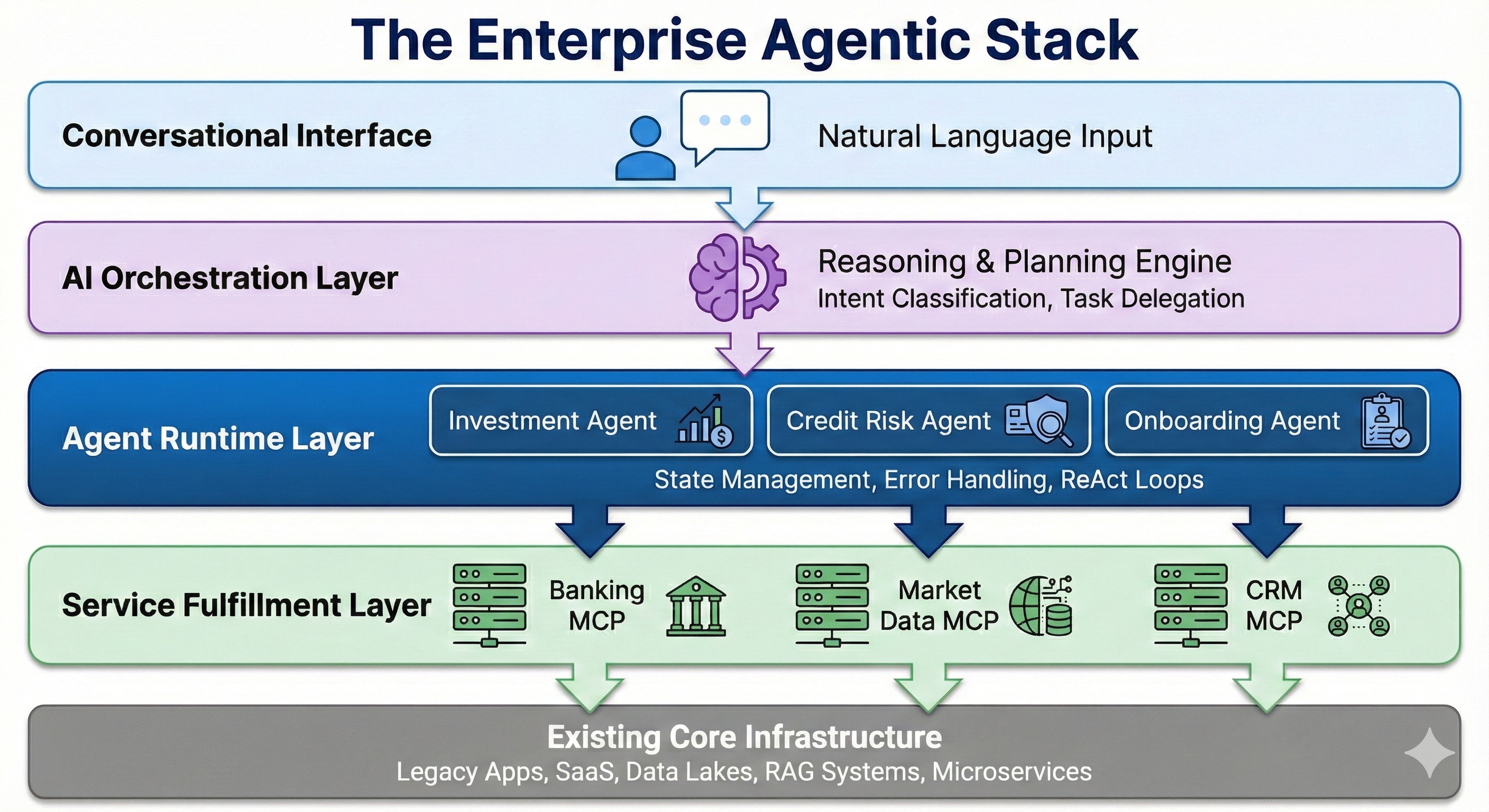
1. The Orchestration Layer (The "Manager")
Sitting below the conversational interface, this layer does not perform work. It is purely the reasoning engine.
Role: Intent classification, high-level planning, and decomposition.
Function: It analyzes a user request ("Rebalance my portfolio based on my risk profile"), breaks it down into a dependency graph, and delegates tasks to specialized workers.
2. The Agent Runtime Layer (The "Specialists")
This is the "Missing Link" in most current deployments. We cannot expect a single generic LLM to handle state, retries, and domain nuances for every task.
Role: Specialized, stateful execution.
Structure: A runtime hosting a mesh of domain-specific agents (e.g., an Investment Agent, a Credit Risk Agent, an Onboarding Agent).
Function: These agents run dedicated control loops (ReAct: Reason + Act). They handle error recovery, maintain the state of the transaction, and ensure business logic integrity before touching the backend.
3. The Service Fulfillment Layer (The "Tools")
This layer represents the evolution of the API Gateway. Instead of brittle, custom-coded integration glue, we deploy a fleet of Model Context Protocol (MCP) Servers.
Role: Deterministic capabilities exposure.
Function: Each MCP Server fronts a specific domain (Banking Core, Market Data, CRM). They expose standardized "tools" that the Agent Runtime layer can discover and invoke safely.
4. Existing Core Infrastructure (The "Foundation")
This is where your data and record-keeping systems live.
Crucial Shift: Note that RAG Systems (Vector DBs, Knowledge Bases) now sit here alongside SQL Databases and Legacy Apps.
Why: In an Agentic architecture, RAG is simply another data utility—a "read-only" dependency that the higher-level agents consume to make informed decisions.
Why this architecture
By inserting the Agent Runtime between the reasoning brain (Orchestration) and the tools (Fulfillment), we solve the "hallucination in production" problem.
The Orchestrator plans, the Agent Runtime validates and executes, and the MCP Servers fulfill. This is how we move beyond "Chat with your Data" to "Autonomous Service Fulfillment".